

India’s inflation broke above the RBI’s 6% ceiling just as hotter US inflation revived the Fed’s tightening story. Bonds sold off on both sides of the world. The Fed Isn’t Done. Neither Is the RBI. Our view, get paid for quality carry and wait before adding duration.
Key Takeaways:
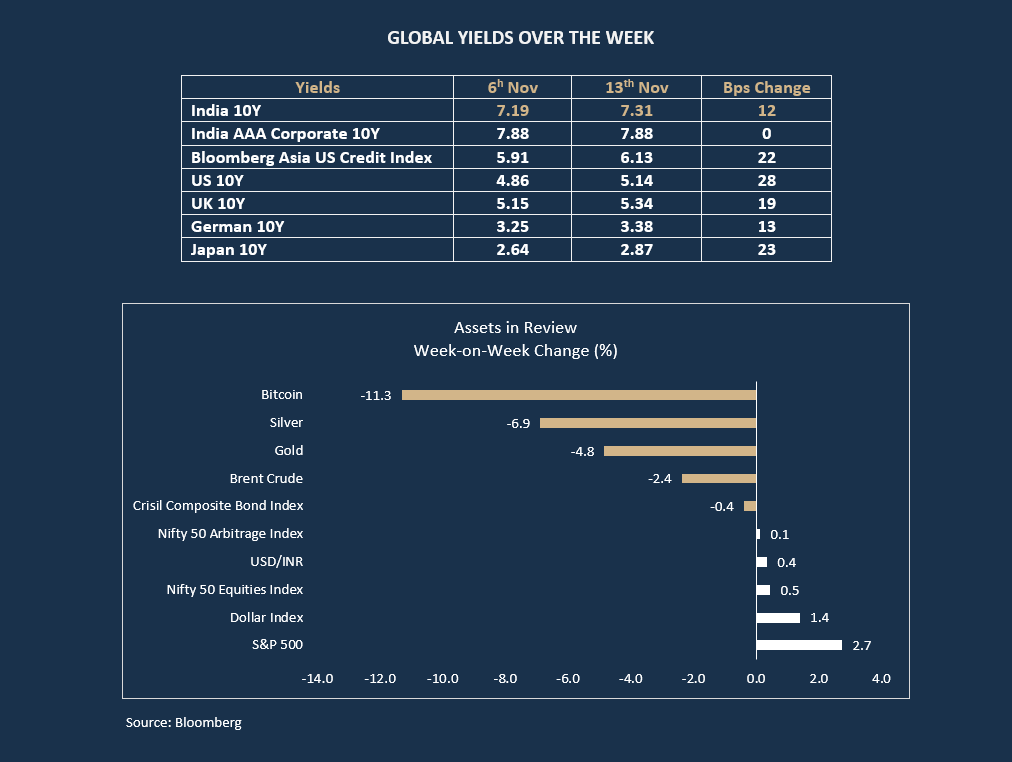
- The US 10-year yield jumped to 5.14% from 4.86%, while Germany’s 10-year yield rose to 3.38% from 3.25%, and Japan’s 10-year yield surged to 2.87% from 2.63%.
- India yields mixed with IGB 10Y rising 12bps at 7.31%, AAA corporate yield stayed flat 7.90%. However, Crisil Composite Bond Index slipped 0.4%.
- Brent futures declined to $96.04/barrel vs $98.32/barrel a week ago (-0.02% WoW).
- Liquidity stayed in surplus at Rs 1.7 trillion from Rs 1.4 trillion a week ago.
- Banking system liquidity may tighten on GST outflows; RBI may have to rely on VRR.
- This week, focus will remain on the movement FOMC minutes and comments from Fed speakers.
- India 10Y yield may trade in between 7.15–7.45%, while Indian rupee is expected to trade in between 94.80–94.50/$ range.
Market Recap:
Last week’s tone was set by a sharp sell-off in US Treasuries, with the 10-year yield surging nearly 28 bps to 5.14%. The trigger was hotter than expected US inflation, which revived expectations of another Fed 25bps rate hike in December. Market participants even began pricing in the possibility of a 50bps move, albeit with a relatively low probability of 12% as per CME Fedwatch. The repricing was also reflected in the shorter end of the curve, with the US 2-year yield rising around 34 bps to 4.86%.
Clearly, bond markets are no longer comfortable assuming that the Fed’s tightening cycle is over. The sell-off in US Treasuries spilled over into Indian bonds, with domestic sentiment further dented by October CPI rising to 6.09%, breaching the RBI’s upper tolerance band of 6%. India’s 10-year G-sec yield reversed its earlier gains to end around 7.31%. The combination of rising domestic inflation risks and a hawkish global rate outlook left little room for a sustained bond-market rally. Corporate bonds, however, remained relatively resilient, with AAA 10-year yields ending broadly flat at around 7.9%, while AAA PSU bonds traded in the 7.9–8.0% range. Primary market activity moderated amid higher borrowing costs and a truncated trading week, with issuances declining to 25 from 37 a week earlier. Tata Capital and NIIF Infrastructure Finance tapped the market at 8.5%, while Regency Fincorp raised funds at 12%. In the secondary market, lower-rated paper such as Lokhadwala Kataria 2028 was reported at a yield of 18.5%, highlighting the elevated credit risk in the pursuit of higher returns.
Money markets remained relatively stable despite the sell-off in G-secs, with short-term borrowing costs largely holding their ground. AAA 3-month CPs and 1-year CDs were offered around 7.85%, making the short end relatively attractive amid rising duration risk. CD issuances declined to 10 from 25 issues a week earlier, while average 3-month CD yields remained broadly unchanged at 7.62%. Bank of India was among the active issuers in the 3-month CD market. Meanwhile, the banking system liquidity continued to remain in surplus above Rs 1 trillion. However, the RBI actively managed overnight conditions through a 4-day VRR operation to meet festive funding demand, followed by multiple VRRR auctions to absorb excess liquidity. This combination of liquidity-injecting and absorbing operations suggests that the RBI remains keen to keep overnight rates anchored around the repo rate (5.50%).
In the primary market, the weekly G-sec auction cut-offs were broadly in line with expectations, with the 6.94% GS 2036 cutoff at 7.32%. T-bill auctions also witnessed healthy demand, with the 91-day (5.87%), 182-day (6.52%) and 364-day (6.64%) papers receiving bid-to-cover ratios of 3.38x, 2.50x and 3.08x, respectively. Similarly, SDL cut-offs were aligned with market expectations, with Gujarat 10-year at 7.82%, Uttar Pradesh 20-year at 8.09% and Tamil Nadu 25-year at 8.08%.
The Indian rupee weakened through the week, ending at around Rs 94.23/$ against Rs 93.90/$ the previous week on the back of stronger dollar and rising US yields. FX Reserves rose by $2.5 billion to $719 billion in the week ended November 6 from $717 billion, largely due to revaluation in gold prices. Meanwhile, US equities, managed to recover on a weekly basis amid continued volatility in technology stocks. The Dollar Index (DXY) strengthened 1.1% to 103.41, as higher Treasury yields and hawkish Fed expectations supported the greenback.
Macro at Glance:
The US inflation print was the week’s biggest market mover. October headline CPI rose 0.4% MoM against expectations of 0.3%, while core CPI also increased 0.3%, above the 0.2% consensus. October PPI rose 0.3%, below expectations of 0.4%, offering some moderation in wholesale price pressures. However, the softer PPI print did little to reverse the broader hawkish repricing following CPI.
On the domestic front, India’s October retail inflation accelerated to 6.09% from 5.54% in September, breaching the RBI’s upper tolerance band for the first time in two years. Food inflation rose sharply to 8.94% from 7.74%, adding to the surprise. The increase was driven by higher food prices, adverse base effects and the pass-through of input and energy costs. The print reinforces our call for a 25 bps hike in December, although a larger 50 bps move cannot be ruled out.
India’s external position also came into focus following the RBI’s September balance of payments (BOP) data. The BOP recorded a surplus of $8.8 billion in September, down from $45.4 billion in August, indicating a moderation in the pace of surplus accumulation. Meanwhile, the October trade deficit widened to a one-year high of $39.9 billion, driven by record high goods imports vs September $30.2 billion. The wider trade deficit, coupled with softer capital inflows, could further moderate the BoP surplus in October.
Outlook:
The coming week will see markets digest the minutes of the Federal Reserve’s October meeting especially as few FOMC members have been hawkish in their recent comments. The geopolitical risks will continue to remain with focus on any renewed escalation in the US-Iran conflict and crude oil prices. For bond investors, the combination of a hawkish global rate outlook and sticky domestic inflation argues against aggressive duration positioning. Selective carry in quality names remains preferable while awaiting better entry levels in longer-duration government securities. India’s 10-year G-sec may trade between 7.15% and 7.45%, while USDINR may remain in the Rs 93.80-94.50/$ range, with crude, dollar strength, US treasury and Fed expectations setting the tone.

Disclaimer: The content of this article is for informational purposes only and should not be considered financial or investment advice. Investments in financial markets are subject to market risks, and past performance is not indicative of future results. Readers are strongly advised to consult a licensed financial expert or advisor for tailored advice before making any investment decisions. The data and information presented in this article may not be accurate, comprehensive, or up-to-date. Readers should not rely solely on the content of this article for any current or future financial reference.