


Diwali came a few days early for Indian bonds. Softer oil and a return of liquidity lit up the market last week, even as US election optimism faded. Our focus remains on quality carry over aggressive duration bets.
Key Takeaways:
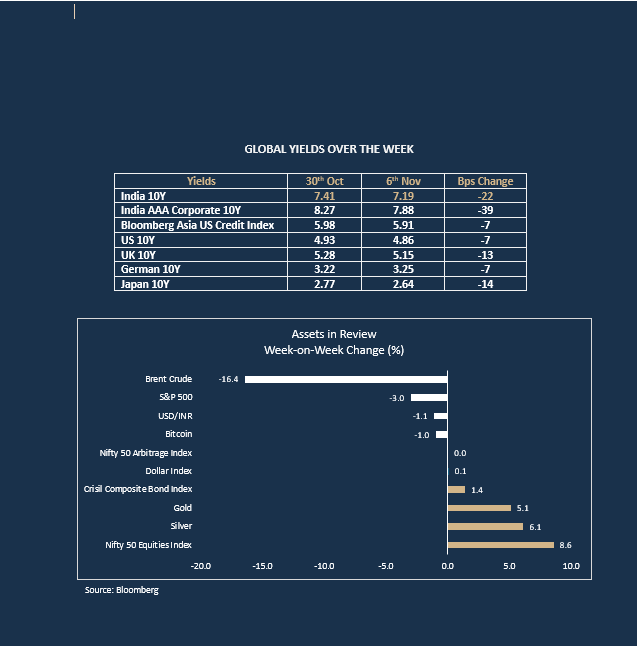
- Brent futures slumped to $98.3/barrel vs $117.6/barrel a week ago (+16% WoW) amid fresh hopes for a diplomatic breakthrough to end the Mideast conflict.
- India yields dropped with IGB 10Y fell 22bps at 7.19%, while AAA corporate yield declined 39bps to 7.88%. However, Crisil Composite Bond Index surged 1.4%.
- The US 10-year yield eased to 4.86% from 4.93%, while Germany’s 10-year yield fell to 3.25% from 3.32%, and Japan’s 10-year yield declined to 2.64% from 2.77%.
- Liquidity surplus stayed around neutral at Rs 2.03 trln.
- Banking system liquidity will continue to stay tight with currency leakage during festival season; RBI may have to rely on VRR.
- This week, focus will remain on the inflation prints from US and India.
- India 10Y yield may trade in between 7.10–7.30%, while Indian rupee is expected to trade in between 93.25–94.25/$ range.
Market Recap:
Indian government bonds recovered some ground, with the 10Y G-Sec yield declining 6 bps to 7.41%, tracking softer Last week’s tone was set by the US midterm elections, and the US equity markets initially rejoiced as Democrats secured control of both chambers of Congress. The result triggered a sharp relief rally, with investors betting on a more constrained policy environment, possible de-escalation in the US-Iran conflict and lower geopolitical risk premiums. But the celebration did not last long. Concerns around AI valuations and potential regulatory curbs on data-centre investments quickly brought investors back to reality.
US equities had a particularly volatile week. The Dow fell 1%, while the S&P 500 and Nasdaq dropped 3.0% and 5.1%, respectively. US Treasuries, meanwhile, benefited from the flight to safety, with the 10-year yield declining around 7 bps to 4.86% from 4.93% the previous week, translating into gains for bond prices. The Dollar Index (DXY), however, recovered towards the end of the week and gained marginally 0.1%, after stronger US employment data reinforced expectations that the Federal Reserve may hike interest rate in December.
Oil had the sharpest reaction to the election outcome. Brent crude fell nearly 16% to end the week around $98.32/bbl, as hopes of a possible de-escalation in the US-Iran conflict prompted investors to unwind part of the geopolitical risk premium. However, Gold gained around 5%, supported by the initial weakness in the dollar, lower Treasury yields and continued uncertainty across global markets. Silver also moved higher by 6%.
For Indian fixed income, the global backdrop offered some relief, particularly through the sharp correction in crude prices, which could help ease imported inflation concerns. Domestically, government bond yields found some support from improving liquidity conditions. India 10Y bond yield closed 22bps lower at 7.19%. Corporate bonds broadly followed the direction of the G-sec market, with yields falling 39bps to 7.88%. The improvement in liquidity also helped sentiment, although the corporate bond market remains dependent on the direction of the G-sec curve and continued demand from banks, mutual funds and other institutional investors. Corporate bond issuance rose to 37 issues from 27 issues a week earlier. Persistent Systems Limited raised Rs 7000 crores around 8.8% via six tranches. Also, Tata Capital Housing Finance Limited, Aditya Birla Capital, Hinduja Leyland Finance tapped the market multiple times. In secondary market segment, Equinox India 2031 was reported at 17.75% yield.
The weekly G-Sec auction result was mixed. The cut off for 7.43% GS 2076 came slightly weaker at 7.77%, while for 7.06% GS 2041 came in line with market expectations of 7.39%. Banks stepped up CD issuances, with 25 in the last week at yields averaging 7.65%, slightly higher from 7.60% a week earlier. Axis Bank, HDFC Bank, Punjab National Bank, bank of Baroda tapped the market multiple times. Meanwhile, RBI didn’t accept bids for 182-day Tbill, the 91-day received strong 6.31x cover (yield 5.90%), the 182-day at 2.23x, and the 364-day at 2.87x (yield 6.65%). Meanwhile, Indian rupee witnessed a sharp rise ending the week at 93.90/$, nearly 7 months high tracking the downside movements in crude oil prices and the dollar index.
Macro at Glance:
The US economic data continued to point towards a resilient economy. October’s ISM Manufacturing PMI improved to 55.5 from 54.5, while the Services PMI remained broadly stable at 54.8 against 54.9 in the previous month. More importantly, October non-farm payrolls increased by 165,000, comfortably above market expectations of around 65,000. The unemployment rate also eased to 4.1% from 4.2%, while wage growth firmed to 0.4% month-on-month. The data has complicated the Fed’s policy outlook. With economic activity holding up and the labour market showing renewed strength, expectations of a December rate hike have firmed. The takeaway is that the Fed may have less room to ease than markets had hoped, keeping global bond yields and the dollar sensitive to incoming inflation data.
India’s private sector activity strengthened in October, with the HSBC Composite PMI rising to 56.2 from 55.9 in September, marking a four-month high. The improvement was led by services, where the PMI climbed to 55.8 from 55.2 on stronger domestic demand and new business growth. Manufacturing, however, moderated to 54.7 from 55.1 as output and domestic orders grew at a slower pace, although export orders touched a six-month high.
India’s foreign exchange reserves continued to decline to $717.06 billion in the week ended October 30, 2026. This follows a decline from the record high of $785.71 billion recorded on September 4, bringing the pace and composition of the drawdown into focus. However, the fall does not necessarily signal a weakening of India’s external position. It reflects a combination of RBI intervention to manage rupee volatility, utilisation of funds mobilised through FCNR(B) deposits and valuation changes in reserve assets due to movements in the dollar.
Outlook:
The coming week will be dominated by inflation data on both sides of the globe. US October CPI is expected to show some moderation, with headline inflation forecast at 0.2% MoM against 0.6% in September, while core CPI is expected to rise 0.2% MoM versus 0.3% previously. However, a softer print may offer limited comfort given persistent underlying price pressures and an increasingly hawkish Fed outlook. Domestically, October CPI is expected to climb to 5.93% from 5.54% in September, nearing the RBI’s 6% upper tolerance band, with food inflation likely to accelerate to 8.2%. A stronger-than-expected print could reinforce expectations of another 25 bps hike in December. The Diwali diyas may have been lit for bonds last week, but a hot CPI print could quickly dim the glow. India’s 10Y G-Sec may trade between 7.10% and 7.30%, while USDINR may trade between 93.25 and 94.25/$, tracking crude oil prices.
Coming Up This Week:

Disclaimer: The content of this article is for informational purposes only and should not be considered financial or investment advice. Investments in financial markets are subject to market risks, and past performance is not indicative of future results. Readers are strongly advised to consult a licensed financial expert or advisor for tailored advice before making any investment decisions. The data and information presented in this article may not be accurate, comprehensive, or up-to-date. Readers should not rely solely on the content of this article for any current or future financial reference.