

Government bonds caught a breather last week, but the cost of borrowing for India Inc. kept rising. For investors, the message is clear: stay short on duration, get paid for quality credit, and let oil and Washington set the pace.
Market Recap:
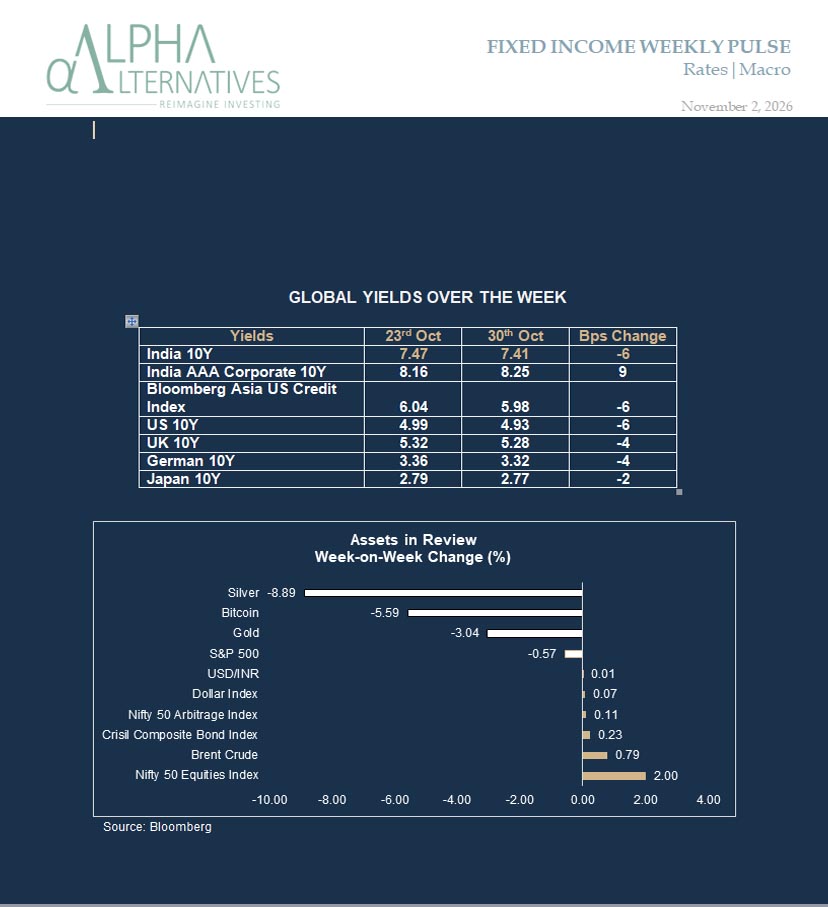
Indian government bonds recovered some ground, with the 10Y G-Sec yield declining 6 bps to 7.41%, tracking softer global yields and renewed buying interest at higher yield levels. The improvement did not extend to corporate bonds, where the 10Y yield rose from 8.16% to 8.27%, reflecting persistent domestic liquidity pressures and continued primary issuance. Banking-system liquidity remained around neutral at Rs 1.38 trillion, weighed down by festive-season currency leakage and RBI FX interventions, while VRR operations helped prevent liquidity from slipping into deficit.
Tight liquidity and limited bank appetite have kept corporate borrowing costs elevated, highlighting the divergence between sovereign and corporate-bond performance; spreads widened by 17 bps. Nearly Rs 1 trillion of CP, CD and NCD maturities are due in the next few days, potentially bringing reinvestment demand into the corporate-bond market. Whether that becomes meaningful buying support will depend on how much of those repayments returns to the market.
The October FOMC meeting was the week’s biggest event. The Fed kept rates unchanged at 3.75-4.00%, as widely expected, but the commentary was far from dovish. Resilient activity, elevated inflation and two dissenting votes favouring a 25 bps hike kept inflation concerns on the committee’s radar. Chair Kevin Warsh offered little clarity on December, keeping a hike on the table. The US 10Y closed 9 bps lower at 4.90%, suggesting that the decline was driven more by broader positioning and subsequent safe-haven demand. Meanwhile, the ECB and BOJ also held rates steady.
US earnings season added to the Fed’s policy dilemma. While earnings remained broadly strong, concerns over massive AI infrastructure spending and uncertain returns triggered a sell-off in technology stocks, with the Nasdaq declining 2.15% over the week. The resulting risk-off sentiment, together with elevated funding costs and market volatility, adds another layer of caution for the Fed.
USD/INR remained broadly unchanged around Rs 94.95 per dollar. RBI intervention likely contained volatility driven by elevated crude prices. In the primary market, 27 corporate-bond issuances took place, while short-term yields rose as banks stepped up CD issuance. The weekly G-Sec auction was broadly in line with expectations.
Macro at Glance:
India’s IIP growth moderated to 6.7% year on year in September from 8.0% in August, largely because of mining weakness, while manufacturing and electricity continued to provide support. The fiscal deficit stood at around Rs 7.14 lakh crore at the end of September, accounting for 42.1% of the FY27 budget estimate. Fiscal slippage of 20-30 bps remains a risk, although stronger corporate tax and GST receipts, disinvestment proceeds and spending cuts in the second half could help contain it.
Outlook:
Markets may remain nervous this week. The US midterm election result on November 3 will be a key event, alongside US employment data and Friday’s non-farm payrolls release. For Indian bonds, softer US data could support global yields, but any post-election escalation with Iran could push crude prices higher and undo much of that relief. The Indian 10Y bond yield may trade between 7.30% and 7.50%, while USD/INR may trade between Rs 94.75 and Rs 95.40 per dollar.