

Oil on the Boil, Liquidity on the Run: Indian Bonds Under Pressure
Oct 26, 2026
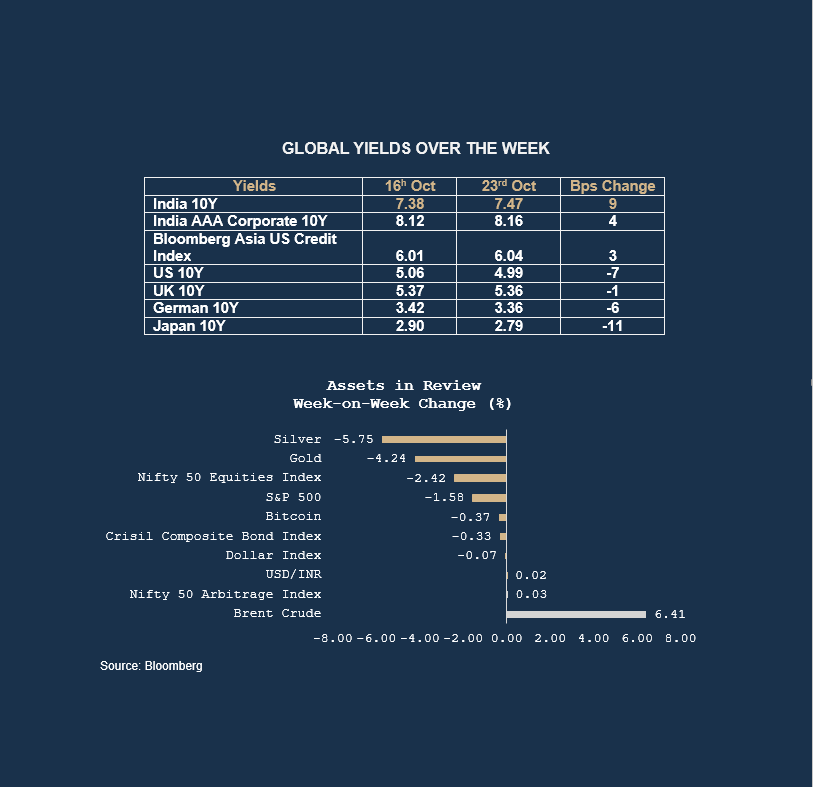 It was another week when oil refused to cool off, Indian bonds fell, gold lost its shine, equities dropped and liquidity tightened. Welcome to a week when almost nothing worked, except staying in cash.
Key Takeaways:
- Brent futures jumped to $117.4/barrel vs $110/barrel a week ago (+6% WoW) amid ongoing Middle East conflict.
- The US 10-year yield eased to 4.99% from 5.08%, while Germany’s 10-year yield fell to 3.36% from 3.42%, and Japan’s 10-year yield declined to 2.80% from 2.94%.
- India yields jumped higher with IGB 10Y rising 9bps at 7.47%, AAA corporate yield rose 4bps to 8.16%. However, Crisil Composite Bond Index slipped 0.3%.
- Liquidity surplus down to Rs 39,083 crore from a record Rs 11.16 lakh crore witnessed on September 6.
- Banking system liquidity will continue to stay tight with currency leakage during festival season and continued RBI intervention; RBI may have to rely on VRR.
- This week, focus will remain on the movement in crude oil prices amid Fed Policy outcome; Less hawkish stance may push US 10Y yields further down.
- India 10Y yield may trade in between 7.35–7.60%, while Indian rupee is expected to trade in between 94.75–95.25/$ range.
Market Recap:
Brent crude climbed to $117/barrel as rising US-Iran tensions and renewed Saudi-Houthi hostilities kept energy supply concerns alive. Indian bonds felt the heat, with the 10-year G-Sec yield rising to 7.47% from 7.38%. Higher crude means a bigger import bill and greater imported-inflation risks for India, leaving little room for optimism in the bond market. Global bond yields, however, eased on safe-haven demand and concerns over whether massive AI investments will deliver adequate returns.
Equities also struggled, with the Nifty down 2.4%, while the S&P 500 fell 2% and Nasdaq tumbled 1%. With US earnings season underway, investors remain focused on whether AI returns can justify the spending. Gold fell 4.4% and silver around 6% despite geopolitical tensions, suggesting inflation risks are overshadowing their safe-haven appeal.
Back home, the RBI minutes reinforced our view that the hawkish turn is real, but tightening is likely to remain gradual. Our AI model scores the minutes 7/10 on hawkishness, assigning a 65% probability to a 25 bps hike to 5.75% on December 4, a 15% chance of a 50 bps hike and a 20% probability of a pause. We expect the repo rate to reach 6.00% by February–April 2027, although much will depend on oil prices and inflation.
Meanwhile, banking-system liquidity tightened sharply towards neutral, contrary to our expectation of a comfortable surplus, falling to Rs 39083 crore as festival cash demand, GST collections, CRR changes and FX intervention drained funds, prompting RBI VRR operations. Banks stepped up CD issuances, with 12 in the last week at yields of 7.50%, up from 6.50% a week earlier. Union Bank tapped the market multiple times, possibly reflecting lower-than-expected FCNR(B) inflows, while most issuances were concentrated in the three-month segment. The squeeze also extended to T-bills, where the RBI rejected all bids amid rising short-term yields, highlighting broader money-market pressure. RBI dollar sales to support the rupee further drained rupee liquidity, reflected in FX reserves falling by $5.01 billion to $721.02 billion in the week ended October 16.
The rupee held steady around Rs 95/$, supported by IPO inflows and recent RBI measures. However, higher forward premiums have made it more expensive for importers to lock in dollar rates. With liquidity also tighter, corporates and oil marketing companies (OMCs) have stayed on the sidelines, delaying hedges on payments due beyond the current month rather than locking in dollars at higher costs.
Corporate bond issuances totaled 18 last week, slightly fewer than a week earlier. Sun Pharma raised Rs 7,816 crore through a twin-tranche issuance at 8.05% and 8.20%, against a Rs 10,000 crore target. In the secondary market, Porteast 2028 (Shapoorji Structured Trade) was reported at a 19.75% yield. The weekly G-Sec auction was broadly in line with expectations, with the 6.53% GS 2031 cut off at 7.36% and the 7.71% GS 2066 at 7.93%.
Macro at Glance:
India’s growth story is sending mixed signals. Growth in the nine-core industries slowed to a three-month low of 4.8% in August, down from a revised 5% in July, as weakness in iron ore and contractions across coal, oil, gas and fertilisers weighed on the headline number. But the picture looks better on the business activity front. The HSBC Flash Composite PMI rose to 56.7 in October from 55.9 in September, supported by stronger new orders, improving services activity and the fastest growth in export orders in six months. With business activity holding up despite the slowdown in core industries, the RBI has some room to focus on inflation without worrying too much about growth. This strengthens the case for another 25 bps rate hike in December, particularly if elevated oil prices continue to add to inflationary pressures.
Outlook:
There’s no relief in sight for crude oil, with concerns that the US and Israel may resume strikes on Iran after the US midterm elections. Warnings suggest that a further escalation could push crude to $150/barrel. This week, markets will be watching the Fed’s policy decision closely. Expectations for the US Fed Funds rate path have moderated since the September FOMC meeting, with no hike priced in for this week’s meeting and a cumulative 50 bps of hikes priced in by March 2027, down from 75 bps earlier. We think a 25 bps hike in December 2026 and another 25 bps in March may be needed, but conviction around a third hike thereafter remains weak. A gradual and modest Fed hiking cycle should also ease some pressure on Indian rates, provided Brent prices do not breach $150/barrel. We expect the India 10-year bond yield to trade in the 7.35–7.60% range, while the Indian rupee may remain range-bound between Rs 94.75-95.25/$.
Coming Up This Week:

Disclaimer: The content of this article is for informational purposes only and should not be considered financial or investment advice. Investments in financial markets are subject to market risks, and past performance is not indicative of future results. Readers are strongly advised to consult a licensed financial expert or advisor for tailored advice before making any investment decisions. The data and information presented in this article may not be accurate, comprehensive, or up-to-date. Readers should not rely solely on the content of this article for any current or future financial reference.