


RBI’s Policy Shift and Tighter FX Rules Amid Market Stress
Oct 12, 2026
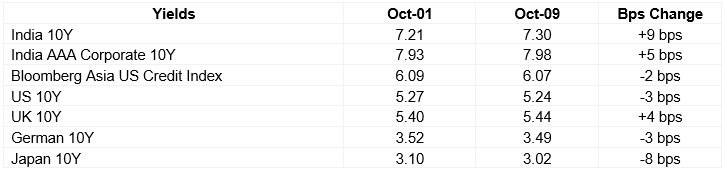
Global Yields over the week
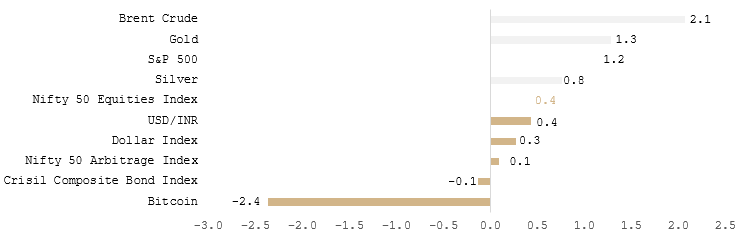
Assets in review
Week-on-Week Change (%)
Key Takeaways:
- RBI announced fresh measures to stabilize the INR as well as tighten banking system liquidity.
- The RBI MPC hiked the repo rate 25bps to 5.5% and moved to a “calibrated tightening” stance, ruling out near-term cuts.
- India’s 10Y G-Sec ended the week at a 3-year high of 7.30% as the sell-off continued.
- The INR ended at 96.78/$ (96.30 a week ago), near its record low. The RBI opened a special dollar window for oil marketing companies.
- Brent futures ended 2% higher at $104.5/barrel on hurricane Isaias related supply disruptions in the Gulf of Mexico.
- US yields pulled back from a 24-year high: the 10Y retreated from 5.37% to 5.24% and the 30Y fell about 13bps to 5.60%.
- RBI announced a Rs.250bn OMO sale to absorb the excess system liquidity.
- India’s September CPI (expected around 5.6%, from 4.82%) and US CPI (around 3.6%, from 3.4%) are the next triggers, with the 10Y expected to trade at 7.35%-7.40% and INR at 95.50-96.00.
Market Recap
On Friday, the RBI announced several measures to prevent INR depreciation and withdraw excess banking-system liquidity. RBI introduced a Special dollar window for oil marketing companies, reduced the limit for FX derivatives to $5 mln from $100 mln without underlying exposure, introduced the Foreign Exchange Risk Reserve (FERR) where banks must maintain an INR reserve with the RBI equal to 20% of the notional value of specified INR-related FX derivative contracts exceeding $2 million. The central bank also prohibited rebooking of cancelled FX derivative contracts and tightened documentation for FX hedging. To absorb durable rupee liquidity from the banking system RBI announced Rs 250 billion of OMO sales, increased minimum daily CRR maintenance from 90% to 99%. These measures came in addition to the RBI MPC policy where it chose to hike interest rate starting with a 25bps rise in repo rate to 5.5% and changing the policy stance to ‘calibrated tightening’, leaving no scope for rate cuts.
Last week, the rupee continued hovering around its record low and ended at 96.78/$ against 96.30/$ a week ago. The FX measures may give some respite to the INR, and the knee-jerk reaction could be positive. Meanwhile, the sell-off continued in the local bond market, with 10Y yield ending the week at a 3-year high of 7.30% on the back of hawkish RBI policy amid higher crude oil prices. Domestic corporate bonds tracked the sovereign move, AAA spreads widened across the curve (2Y +5bps, 5Y +2bps, 10Y +5bps). The 1Y OIS held around 6.06%, suggesting the market has already priced in a cumulative 75bps of hikes. There were 20 corporate bond issuances during the week, with Bajaj Housing Finance recording the highest allocation of Rs 2,500 crore at a yield of 8.45%. In the Certificate of Deposit (CD) market, 13 issuances were recorded, with Bank of Baroda, Axis Bank and Canara Bank tapping the market multiple times. The heavy quantum was seen in 6M CD. Liquidity in banking system stayed in surplus at Rs 3.88 trln as on Oct 8 compared to Rs 5.15 trln a week ago. Meanwhile, the weekly G-sec auction was broadly on expected lines with 7.06% GS 2041 coming at 7.49% and 7.43% GS 2076 at 7.80%. T-Bills also cleared well: the 91-day at a strong 4.84x cover (yield 5.58%), the 182-day at 2.51x (yield 6.09%), and the 364-day at 1.94x (yield 6.29%).
Globally, the yield on US 10Y treasury retraced from its highest level since 2002 (5.37%) as traders digested comments from a top Federal Reserve official along with another long-dated (30-year) bond auction. Meanwhile, FOMC minutes also failed on hinting when could the next rate hike take place. Further, President Donald Trump’s remarks on US not attacking Iran until after the November mid-term elections, also kept the 10Y yield subdued along with falling crude prices.
Outlook:
Indian bonds are likely to remain under pressure through the week, with 10Y bond yield expected to rise 4–5 bps following the RBI’s announcement of the OMO sale. The focus will shift to September CPI inflation, expected to rise to around 5.6% from 4.82% in August, driven by elevated food prices, higher energy costs and adverse base effects. Meanwhile, the US September CPI is also expected to rise to around 3.6% from 3.4% in August, and will be another key trigger, with an upside surprise potentially pushing US Treasury yields and the dollar higher, adding to pressure on domestic bonds and the rupee. Meanwhile, RBI’s FX measures could help contain near-term rupee volatility. The 10Y bond yield is expected to trade within range of 7.35%-7.40% during the week while INR may trade in between 95.50-96.00.
Coming Up This Week:

Disclaimer: The content of this article is for informational purposes only and should not be considered financial or investment advice. Investments in financial markets are subject to market risks, and past performance is not indicative of future results. Readers are strongly advised to consult a licensed financial expert or advisor for tailored advice before making any investment decisions. The data and information presented in this article may not be accurate, comprehensive, or up-to-date. Readers should not rely solely on the content of this article for any current or future financial reference.