
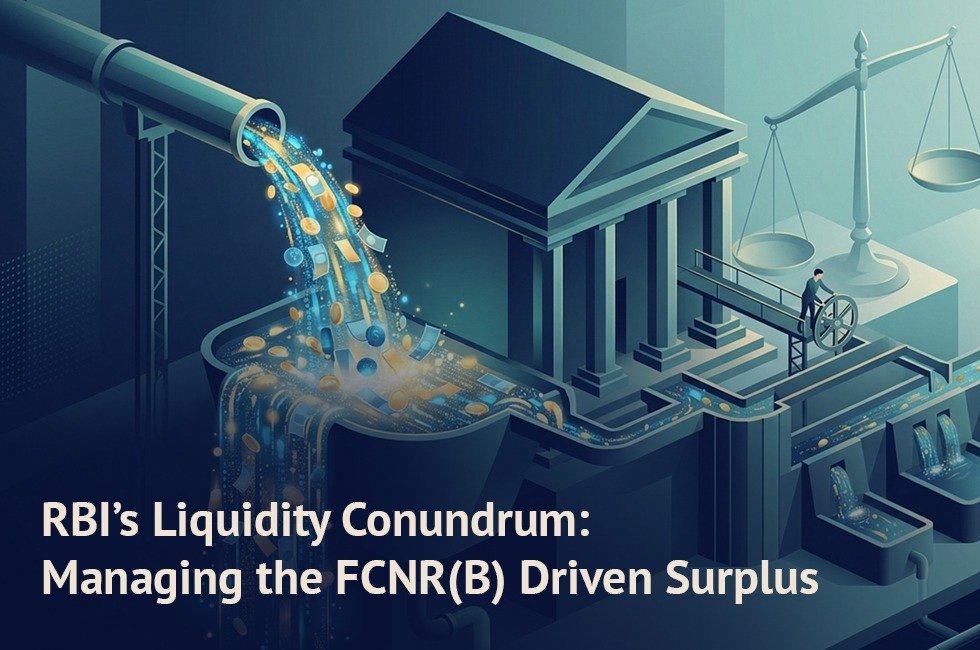
RBI’s Liquidity Conundrum: Managing the FCNR(B) driven surplus
September 10, 2026
To counter the significant sell-off in the INR against the dollar and attract foreign capital from NRIs, the RBI introduced a concessional forex swap facility for fresh FCNR(B) deposits, alongside other measures to strengthen India’s balance of payments. In June, the central bank introduced the USDINR Forex Swap Facility for fresh FCNR(B) deposits mobilised for 3–5 years. Banks were allowed to tap the zero-cost hedging facility for overseas FX deposits raised until September 30. However, given the encouraging response to FCNR(B) deposits and the resultant forex inflows, the RBI decided to close the facility by August 31, while keeping the ECB and OFCB facilities open until December 31.
Bumper inflows create a liquidity challenge
The FX countermeasures attracted bumper inflows of around $136 billion in just three months until end-August. FCNR(B) flows accounted for around $127 billion, significantly higher than the $26 billion attracted during the historic 2013 taper tantrum. OFCBs attracted around $5 billion, while ECBs attracted around $4 billion, with both expected to continue generating inflows until December 31. Most of these inflows are being absorbed by the central bank, pushing FX reserves to a record high of $740.80 billion.
However, the inflows have also created a significant domestic liquidity challenge. The primary transmission mechanism of the FCNR(B) scheme is the conversion of foreign currency deposits into INR liquidity by commercial banks under the RBI’s swap facility, resulting in surplus liquidity in the banking system.
Net liquidity surplus consequently peaked at a record Rs 11.2 trillion, equivalent to around 5% of NDTL, as of September 6, 2026. With a portion of the concessional swap-related inflows continuing until December 2026, liquidity is expected to remain elevated.
Surplus liquidity complicates monetary policy
The liquidity surplus comes at a challenging time. Global bond yields are near multi-decade highs, compressing India-US rate differentials, while major central banks continue monetary tightening. At the same time, domestic inflation is expected to move closer to the upper end of the RBI’s 2–6% target band. A large and persistent liquidity surplus could therefore add to inflationary pressures and encourage more aggressive credit expansion, particularly towards less productive sectors of the economy.
The RBI has already conducted multiple Variable Rate Reverse Repo (VRRR) auctions, including 15-day and 30-day operations, to steer liquidity closer to its neutral level of around 1% of NDTL. However, these operations have absorbed only a marginal portion of the surplus, indicating that additional measures may be required.
RBI’s liquidity toolkit
The RBI has several instruments available to absorb excess liquidity, including reverse repos, maturity of outstanding FX forwards, OMO sales, FX spot sales, FX sell/buy swaps and I-CRR. The Government can also issue short-term instruments such as Cash Management Bills (CMBs), T-bills and MSS securities in coordination with the RBI.
Government cash balances stood at around Rs 4.3 trillion as of August 15 and are expected to have risen on the back of GST and advance tax flows by end-September. While CMBs are generally used to address lower government cash balances, under the current circumstances, CMB/T-bill issuance would be a more immediate and operationally convenient option than MSS.
However, we expect the RBI to initially rely on long-tenor reverse repos and the maturity of its outstanding short USD forward positions, with other measures likely to be considered only if the initial response proves insufficient.
Reverse repos and FX-forward maturities likely to lead the response
We see scope for around Rs 1–2 trillion of Variable rate reverse repos (VRRR) over 3–6 months to absorb the surplus without putting undue pressure on money-market rates. The RBI can also deliver USD against the maturity of its outstanding short USD forward positions, thereby withdrawing INR liquidity from the banking system. We expect around USD 20–30 billion of these positions could mature without rollover. This would be a prudent approach given the significant short USD exposure already accumulated through the RBI’s longer-tenor FX swap facilities. With FX reserves at comfortable levels, there appears to be limited rationale for continuously rolling over these positions. Allowing the forwards to mature would therefore provide an additional channel for absorbing excess INR liquidity.
I-CRR, OMO and MSS less likely initially
Market participants have discussed bringing back the incremental Cash Reserve Ratio (I-CRR), last used in 2023 to absorb excess liquidity. However, its reintroduction appears unlikely given the RBI’s recent policy measures. The RBI has allowed incremental deposits raised through the discounted FCNR(B) swap facility to remain exempt from CRR and SLR requirements, enabling banks to offer more competitive rates on these deposits. An additional reserve requirement could therefore undermine the incentive provided under the scheme and could be punitive for smaller banks.
Similarly, large-scale OMO sales appear less likely following the RBI’s sizeable G-sec purchases, while MSS issuance appears to be a less likely option given the government’s focus on fiscal discipline. That said, if liquidity remains persistently elevated, OMO sales and/or MSS could be considered at a later stage.
FX intervention can provide additional sterilisation
The INR continues to face a depreciation bias amid an adverse global backdrop. Higher global yields, a stronger DXY, a hawkish Fed, geopolitical risks and elevated crude prices could keep USDINR biased higher. This may prompt the RBI to continue intervening in the FX market to manage volatility, although at a slower pace. Sustained dollar sales would simultaneously withdraw INR liquidity from the banking system, helping absorb part of the surplus over the coming months.
However, the RBI may remain cautious in deploying FX sell/buy swaps, given the need to preserve adequate FX reserve buffers amid elevated global uncertainty. Shorter-tenor FX swaps could nevertheless be used tactically to address timing mismatches in liquidity flows.
Implications for banks
The robust FCNR(B) flows have already reduced banks’ dependence on higher-cost Certificates of Deposit (CDs). In August, banks raised Rs 681 billion through CDs, the lowest since April, when issuances stood at Rs 457 billion. The liquidity surplus should support credit expansion, particularly short-term lending, while enabling refinancing agencies to prepay costlier loans. Banks’ LCR could improve by up to 1 percentage point.
Banks may also offer 2–3 year fixed-rate teaser loans to lock in spreads. Some banks may prefer lending over bond purchases, as loans are not subject to MTM volatility. This could partly explain the muted response to VRRR auctions, as banks may prefer deploying surplus liquidity into credit rather than parking funds with the RBI.
At the same time, banks are increasing deployment into the bond market, particularly short-duration G-secs and high-grade corporate bonds. Banks appear to favour large, well-rated issuers where spreads remain attractive without taking significant credit risk. Recent reports of large private-sector banks underwriting sizeable corporate bond issuances are an early indication of this trend.
Lower deposit costs following the FCNR(B) inflows should also allow banks to reduce benchmark lending rates, creating further room for credit growth. With asset quality remaining comfortable and capital buffers healthy, the banking system is well placed to expand its balance sheet. Over the medium term, the larger deposit base and lower funding costs should support bank NIMs.
Implications for the bond market
The immediate impact of the liquidity surplus should be most visible at the short end of the curve, with abundant liquidity keeping money-market conditions and short-term yields soft. However, the surplus is unlikely to result in a sustained decline in domestic interest rates. The RBI is expected to sterilise a meaningful portion of the excess liquidity through reverse repos and the maturity of outstanding FX forwards, limiting the extent to which surplus liquidity translates into broader monetary easing.
The global rate environment is also less supportive. Major-market bond yields remain elevated amid persistent inflation concerns and higher energy prices, while the prospect of further tightening by major central banks and a potentially higher domestic inflation trajectory limits the scope for aggressive RBI easing.
Therefore, the liquidity surplus should support the short end, but medium- and long-duration yields are likely to remain anchored by global yields, inflation risks, narrowing interest-rate differentials and the RBI’s policy stance.
View
In our view, the FCNR(B)-driven liquidity surplus is more likely to support credit growth and compress bank funding costs than trigger a sustained decline in market interest rates. The RBI’s first line of response is likely to be long-tenor reverse repos and the maturity of outstanding short USD forward positions. We see scope for around Rs 1–2 trillion of reverse repos over 3–6 months, along with around USD 20–30 billion of short USD forwards maturing without rollover. If the surplus persists, the RBI could subsequently consider OMO sales and/or MSS, while shorter-tenor FX swaps could be used tactically. An I-CRR hike appears unlikely given the exemption provided to FCNR(B) deposits.
The key concern is that sustained surplus liquidity could eventually add to inflationary pressures and encourage excessive credit expansion. While this should be positive for bank NIMs, with select private and PSU banks likely to benefit disproportionately, the implications for bonds remain more nuanced.
We therefore maintain a cautious duration stance, with a preference for the short-to-medium end of the curve, where carry remains attractive and the risk from a global or domestic rate repricing is more contained.
Disclaimer: The content of this article is for informational purposes only and should not be considered financial or investment advice. Investments in financial markets are subject to market risks, and past performance is not indicative of future results. Readers are strongly advised to consult a licensed financial expert or advisor for tailored advice before making any investment decisions. The data and information presented in this article may not be accurate, comprehensive, or up-to-date. Readers should not rely solely on the content of this article for any current or future financial reference.