

Global rate relief supports G-Secs, but widening corporate spreads offer better value. Lock in quality carry before funding costs rise. Importers may likely stay hedged, while exporters may maintain hedge cover as the rupee moves towards 93/$.
Key Takeaways:
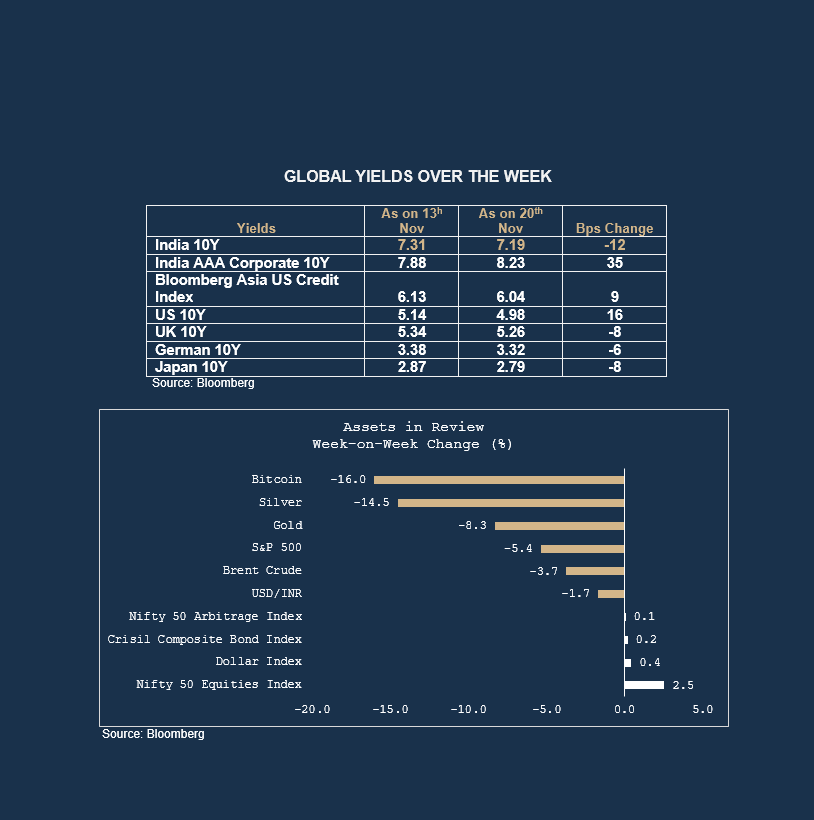
- The US 10-year yield fell to 4.94% from 5.15%, while Germany’s 10-year yield dropped to 3.32% from 3.38%, and Japan’s 10-year yield surged to 2.79% from 2.87%.
- India yields mixed with IGB 10Y fell 12bps at 7.19%, AAA corporate yield rose to 8.23%. However, Crisil Composite Bond Index rose 0.2%.
Brent futures declined to $92.58/barrel vs $96.04/barrel a week ago (-4% WoW). - Liquidity in surplus tightened to Rs 78,800 crores on likely GST outflows, from Rs 1.7 trillion a week ago.
- This week, focus will remain on the US economic data and comments from Fed speakers.
- India 10Y yield may trade in between 7.10–7.40%, while Indian rupee is expected to trade in between 92–93/$ range.
Market Recap:
Global markets turned defensive as concerns around AI valuations triggered a sell-off in US equities. The S&P 500 and Nasdaq weakened, while investors moved towards US treasuries. The US 10-year yield fell to 4.94% from 5.15%, as safe-haven demand outweighed hawkish signals in the October Federal Open Market Committee (FOMC) minutes. Brent fell 4% to $92.6/bbl as rising supplies and US inventories outweighed geopolitical risks. However, Strait of Hormuz tensions kept $90 support intact. The bias remains lower; a sustained break below $90/barrel would ease India’s import bill and inflationary pressures.
Indian G-Secs followed the global move, with the 10-year benchmark yield declining 12 bps to 7.19%. Softer US yields, lower crude prices and rupee appreciation supported domestic bonds. However, corporate bonds moved in the opposite direction to G-Secs. The 10-year AAA corporate yield rose to 8.23%, widening spreads over government securities. With AAA PSU bonds offering 8.00-8.02%, the relative value proposition has improved. G-Secs rallied, but corporate bonds became cheaper. That is where investors may look for carry.
Indian rupee was the week’s outlier. It appreciated to Rs 92.67/$ despite a stronger Dollar Index (DXY) and weakness across EM currencies. Lower crude prices, foreign inflows and unwinding of bearish rupee positions supported the recovery. Last week, FII bought ~$3.5 billion worth of equities and ~$59 million worth debt, so the move suggests INR-specific buying rather than broad dollar weakness. Indian equities defied global weakness, with the Nifty 50 rising 2.6% to 25,800.60, extending gains for a fourth straight week. Domestic buying and FII inflows supported the rally, keeping Indian markets resilient despite a global technology led sell-off.
Banking system liquidity surplus tightened to Rs 78,800 crore as GST-related outflows coincided with repeated VRRR operations, prompting banks to step up short-term borrowings. Three-month CD issuances more than doubled to 23 from 10 last week, with Punjab National Bank among the active issuers. However, funding costs remained stable, with average 3-month CD yields at 7.5% and AAA CPs offered around 7.7%. to offset the liquidity drainage, the RBI also, stepped in with multiple Variable Repo Rate (VRR) operation. This two-way liquidity management reflects the RBI’s effort to smoothen temporary liquidity mismatches and keep overnight rates anchored around the 5.50% repo rate.
In the primary market, the weekly G-Sec auction was slightly better than expectations with 6.53% GS 2031 cut-off at 7.11% and 7.71% GS 2066 at 7.81%. The T-Bill auction recorded strong demand, with bid-to-cover ratios of 3.15x, 3.32x and 3.60x for 3-month, 6-month and 1-year T-Bills, respectively. Cut-off yields stood at 5.86%, 6.53% and 6.63%, respectively.
Macro at Glance:
The October Federal Open Market Committee (FOMC) minutes reinforced the Fed’s hawkish bias. Two members dissented in favour of a 25 bps hike, while participants remained concerned about persistent inflation. Some also indicated that further tightening could be warranted if inflation failed to moderate. The subsequent fall in Treasury yields reflected safe-haven demand, not a change in the Fed’s inflation concerns. As per Chicago Mercantile Exchange (CME) Fedwatch, the probability of December rate hike of 25bps stands around 89%.
Domestic wholesale price pressures intensified, with October Wholesale Price Index (WPI) climbing to a four-year high of 12.3% from 11.4% a month ago. Higher energy costs, spanning crude, petroleum products, thermal coal and electricity, drove the increase, partly cushioned by an unusual decline in vegetable prices. Output Producers Price Index (OPPI) inflation also accelerated, reflecting higher costs in refined petroleum products and electricity. The divergence suggests that domestic cost pressures are building, while the full impact of global price movements is yet to pass through.
India’s forex reserves declined by $14.2 billion to $705.34 billion in the week ended November 13, with Foreign Currency Assets (FCA) falling $7.9 billion and gold reserves declining $6.2 billion. The fall reflects adverse valuation effects from a stronger US dollar, rising US Treasury yields and lower gold prices. Hence, the decline should not be interpreted entirely as active dollar intervention by the RBI.
Outlook:
Markets will focus on incoming US data, commentary from FOMC members and whether the global equity correction continues. At home, the RBI’s policy on 2–4 December is now the key event, and the case for a bigger move is building. Growth is holding up, with the composite Purchasing Managers’ Index (PMI) at a four-month high. Inflation is moving the wrong way: Consumer Price Index (CPI) is at 6.09%, above the tolerance band, and WPI is at a four-year high of 12.3%, which points to more pass-through to retail prices in the coming months. The rupee has recovered over the past two weeks on strong FPI equity inflows, but that support depends on flows that can reverse quickly, and the risks from oil, a firm dollar and a hawkish Fed have not gone away.
Against this backdrop, we believe the RBI could choose to front-load tightening. We see two likely outcomes:
1. A hawkish 25 bps hike: a smaller move, but with a clear signal that more tightening may follow if inflation does not ease.
2. A dovish 50 bps hike: a larger, front-loaded move to get ahead of inflation, delivered with a measured tone and future action left dependent on incoming data.
Either way, policy is heading tighter, and the December statement’s guidance matters as much as the size of the hike. We suggest investors stay cautious at this stage. For those looking to deploy, select AA-rated NBFC papers currently offered in the 9.75–10% range look attractive for accrual. India’s 10-year G-Sec may trade between 7.10% and 7.40%, while USDINR may stay in the 92–93/$ range, with global yields, crude, liquidity and RBI expectations setting the tone.
Coming Up This Week:

Disclaimer: The content of this article is for informational purposes only and should not be considered financial or investment advice. Investments in financial markets are subject to market risks, and past performance is not indicative of future results. Readers are strongly advised to consult a licensed financial expert or advisor for tailored advice before making any investment decisions. The data and information presented in this article may not be accurate, comprehensive, or up-to-date. Readers should not rely solely on the content of this article for any current or future financial reference.