

Market Recap:
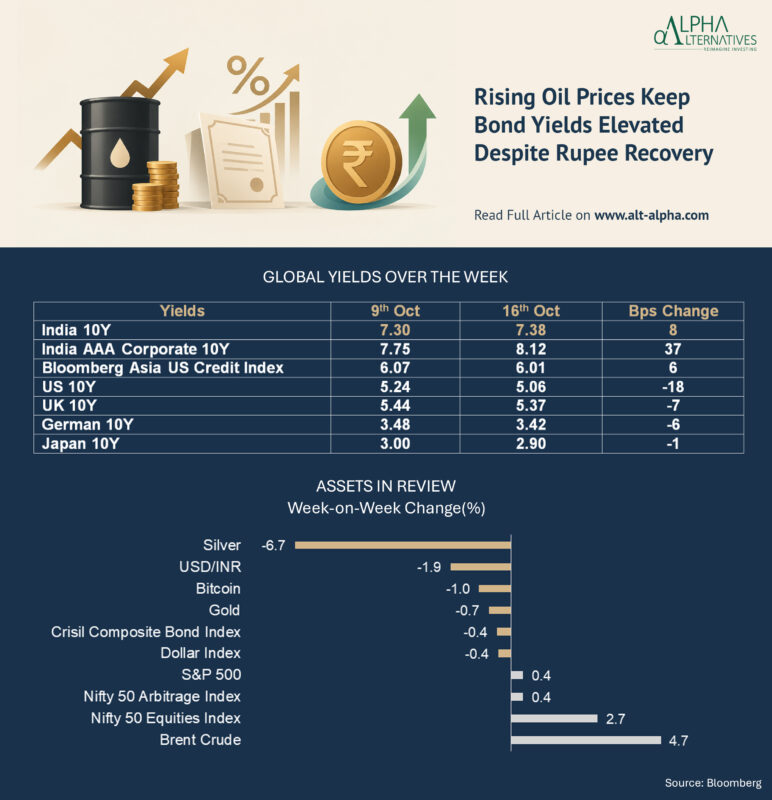
Last week, local bond yields remained elevated amid rising crude oil prices, with the 10-year G-sec yield closing 8bps higher at 7.38% from 7.30% a week ago. Domestic corporate bonds tracked the sovereign move, 10Y AAA spread widened to 74 bps from 45 bps (2Y +7bps, 5Y +2bps). The 1Y OIS rose to 6.55% from 6.24% a week ago, suggesting the market participants are pricing in a cumulative 75-100bps of rate hikes. Meanwhile, the Indian rupee appreciated 2% against the US dollar last week, marking its biggest weekly gain in seven months, to close at 94.96/$ from 96.78/$. The recovery followed RBI measures to support the currency, including redirecting oil-related dollar demand away from the spot market and increasing the cost of hedging against rupee depreciation. However, the latest FX curbs disrupted market liquidity and made it harder for traders to manage exposures, pushing USD/INR forward premiums to multi-year highs.
On the global front, US Treasuries rallied as AI-related fears triggered a risk-off move in equities, prompting investors to shift towards safe-haven assets. Meanwhile, higher US CPI inflation, which rose to 3.7% in September from 3.4% in August, heightened concerns over economic growth and the impact of tighter monetary policy. Against this backdrop, the US 10Y bond yield declined 18 bps over the week to 5.06% from 5.24%. However, Indian government bonds decoupled from the rally in US Treasuries, resulting in a 24 bps widening in the India-US 10-year yield spread, as domestic factors continued to drive local bond yields.
Macro at Glance:
On the macro front, it was a data heavy week starting with India’s CPI inflation rising to 5.5% in Sep from 4.8% in Aug largely on food and transmission of global price shocks. India’s core CPI saw some momentum in its demand side as it rose to 4.3% in September from 4.2% a month ago. Meanwhile, India’s WPI accelerated to 11.4% in Sep from 9.9% in August mainly on account of higher food and fuel prices and increasing prices in the major group of manufactured products. Further, India’s trade deficit data for Sep widened by $3 bln MoM to $30 bln as imports grew faster than exports. The rising oil prices and supply disruptions due to US Iran conflict led to rise in oil prices in Sep which got reflected in the trade data. While, the August Balance of Payments (BOP) surplus surged to $45.4 bln in August from $20.8 bln in July, driven primarily by strong NRI deposit inflows under the FCNR(B) scheme.
The banking system liquidity surplus fell to around Rs 2.4 trln as on Oct 15 compared to Rs 3.8 trln a week ago likely on the back of muted government spending, aggressive FX intervention by the RBI, and RBI’s liquidity withdrawal measures such as OMO sales, FERR. Going ahead, the liquidity surplus may continue moderate further due to continued direct FX intervention and high festive season led-CIC leakage. While, India’s FX Reserves dropped by $8.6 bln to $726 bln as on week ending Oct 9, marking a fifth consecutive weekly decline on heavy RBI intervention in FX market to support depreciation in INR and valuation losses in gold. So far, the RBI has shed $60 bln from its kitty since reaching a record $786 Bln in the week-ended Sep 4. Despite the recent drawdown, India retains import cover of about 10 months.
Locally, 21 corporate bond issuances took place last week, with 3Y SIDBI recording the highest allocation of Rs 5,176 crore at a yield of 8.05%. Monedo Financial Services Ltd, Neogrowth Credit Private Ltd and Akara Capital Advisors offered the highest yields among the issuances. As the banking liquidity surplus is getting absorbed, we are seeing a pickup in the shorter end of the curve. The CD market saw 12 issuances last week, with Bank of Baroda and Punjab National Bank tapping the market multiple times, while issuance volumes were concentrated in the 3-month segment. Meanwhile, the weekly Gsec auction was broadly on expected lines with 6.94% GS 2036 coming at 7.3955%. The T-Bills also cleared well with the 91-day at a strong 3.08x cover (yield 5.69%), the 182-day at 1.97x (yield 6.25%), and the 364-day at 1.73x (yield 6.44%).
Outlook:
This is a truncated week with a relatively light domestic data calendar, keeping investor focus on crude oil prices and key developments in the Russia-Ukraine conflict. Key events to watch include the RBI MPC meeting minutes, which are expected to reflect a hawkish tone in line with the policy stance, UK inflation data, US labour market readings, and the much-awaited initial public offering of Jio Platforms Ltd. Also, in the US, Meta Platforms (October 21) and Intel (October 22) are scheduled to report Q3 earnings. Meanwhile, local liquidity in the banking system may moderate and stay around Rs 2 trln on GST outflows, festive season led increase in currency in circulation, likely RBI intervention in FX market. The 10Y bond yield will be guided by the movement in crude oil prices and RBI minutes and may trade in between 7.30-7.40%, while Indian rupee is expected to trade in between 94.50–95.25 range.