

|
Yields |
25th Sep |
1st Oct |
Bps Change |
|
India 10Y |
7.12 |
7.21 |
9 |
|
India AAA Corporate 10Y |
7.83 |
7.93 |
10 |
|
Bloomberg Asia US Credit Index |
5.97 |
6.09 |
12 |
|
US 10Y |
5.17 |
5.27 |
10 |
|
UK 10Y |
5.35 |
5.37 |
2 |
|
German 10Y |
3.60 |
3.46 |
-14 |
|
Japan 10Y |
3.08 |
3.08 |
0 |
Market Recap:
Key Takeaways:
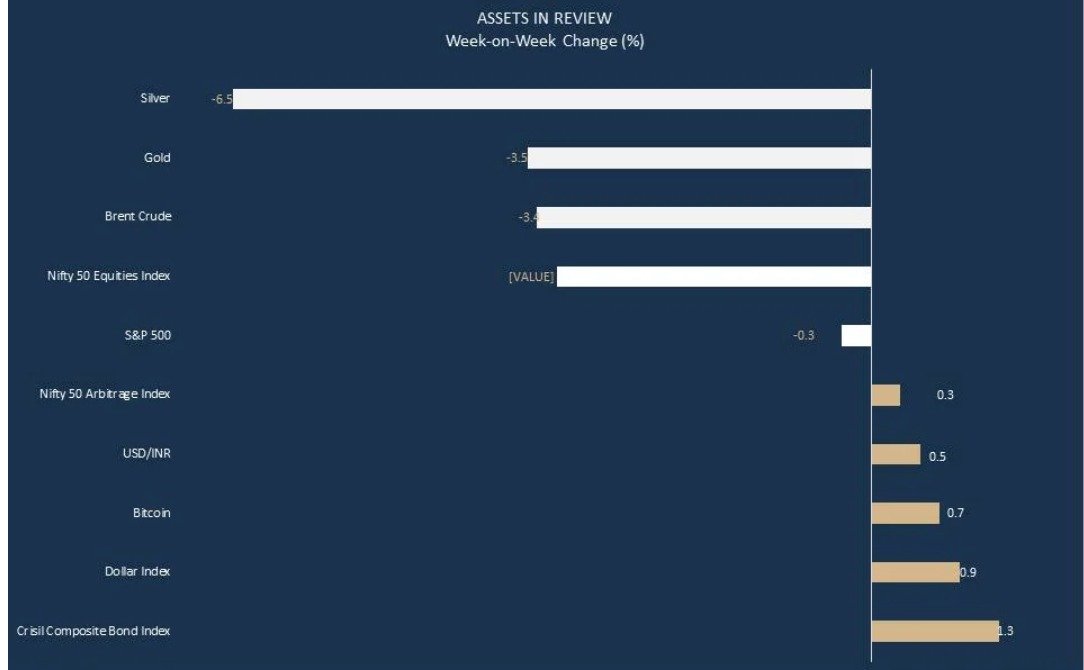
- Global yields rose broadly: US 10Y led at +11bps to 5.27%, the Bloomberg Asia USD Credit Index (+12bps). India yields followed (10Y +9bps, AAA corporate +10bps).
- Nifty 50 (-3.2%) and Nifty 500 (-3.4%) fell and the Crisil Composite Bond Index slipped 0.3%. The Nifty 50 Arbitrage Index rose (0.3%).
- DXY rose 0.90% but USD/INR ended higher (0.5% at 96.32), consistent with RBI’s active FX intervention.
- Brent subdued 3.4% to $102 after seven major oil-exporting countries agreed to keep production steady, while gold (-3.5%) and silver (-6.5%) fell on higher yields and a robust dollar.
- US NFP rose by 29K in September, followed the 133K increase recorded in August (revised from 162K) and missed the market expectation of 90K by a wide margin.
Last week, crude oil prices was the main driver for the markets with Brent breaching $104/barrel as President Trump rejected Iran’s proposal to reopen the Strait of Hormuz and end the fighting. However, recovering Gulf exports and a coordinated Group of Seven and International Energy Agency plan to release 100 million barrels of crude and diesel reserves eased some of the crude supply premium. Global bond yields stayed higher as brutal bonds selloff gathered pace. The US 30-year Treasury yield surged to 5.61%, level last in 2002 while 10-year Treasury yield hit 5.34%, its highest level in 24 years despite the softer US inflation readings and cautious remarks from Fed officials regarding the need for further policy tightening. The likelihood of consecutive rate hikes have diminished following comments from New York Fed President John Williams and Fed Vice Chair Philip Jefferson, who suggested that policymakers have sufficient time to assess the need for further increases later this year. In addition, methodological changes to the calculation of the US PCE deflator resulted in a more pronounced slowdown in core inflation over the summer, while the Nonfarm payrolls slowed sharply. The recent developments do not completely rule out another rate hike as soon as this month, it now appears less likely.
India’s bond market stayed subdued amidst selling pressure driven by higher global bond yields,
elevated crude oil prices, rupee weakness and rising concerns about inflation. 1Y OIS surged to 6.25%(+10bps), pricing in 75bps rate hikes in next one-year. The domestic corporate bonds followed the move in Gsec. The banking system liquidity stayed in surplus but has tightened markedly to 1.7% of NDTL from a peak of 4%, with overnight rates also rising back, partly on account of excise, advance tax and GST collections. However, these have also been added to by drains from early delivery of RBI short positions, OMO sale as well as active intervention in the FX market. The structural trend in INR remained bearish against the dollar, driven by oil prices, depreciating to 96.33/$. Meanwhile, Nifty weighed down by weak domestic and global signals.
Macro at Glance:
India’s fiscal deficit widened to Rs 7.1 trln in the first five months of the current financial year through August, accounting for 41.9% of the government’s full-year Budget Estimate. The fiscal deficit stood at 38.1% of the annual target in the corresponding April-August period a year earlier. The Centre has budgeted a fiscal deficit of Rs 16.96 trln for FY27. Total receipts stood at Rs 13.68 trln during April-August, equivalent to 37.5% of the full-year Budget Estimate of Rs 36.52 trln. Total expenditure, meanwhile, reached Rs 20.78 trln, or 38.9% of the Rs 53.47 trln budgeted for the financial year.
Outlook:
Focus will remain on RBI policy where we expect the start of the rate hiking cycle, with a 25bps repo rate increase. The neutral stance is likely to be retained, and the rate hiking cycle may be shallow, with cumulative hikes of 50-75bps until February 2027. The need for rate hikes will be driven by the need to prevent the real policy rate from becoming negative for an extended period as local inflation continues to pick up. Given the higher longer end supply, the local yield curve could bear flatten if RBI Governor sounds hawkish.