

CPI at 4.8%: Worry for RBI?
September 17, 2026
India’s CPI inflation inched up to 4.8% YoY in August after increasing by 4.5% in July. The headline number surpassed the Reserve Bank of India’s medium-term target of 4% for the third consecutive month but came in line with market expectations. CPI inflation was 2.01% in August last year.
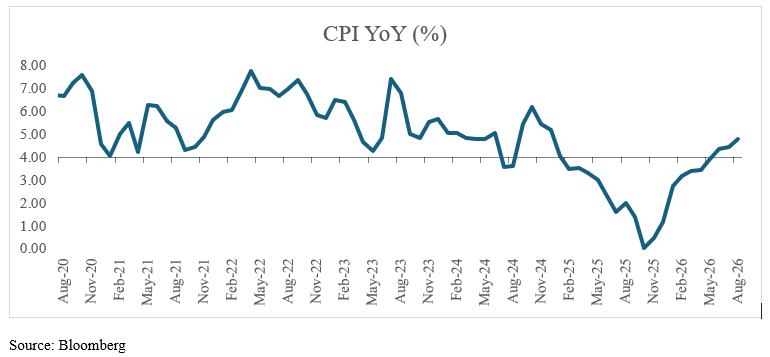
Rural inflation for August 2026 was recorded at 5.23%, whereas urban inflation was lower at 4.31%. The July CPI inflation was revised marginally higher from 4.4%. Overall, the rise in inflation was led by food and beverages inflation, which rose to 5.7% in August from 5.2% in July. Inflation pressures within the food basket are becoming broad-based, in contribution terms, the rise was led by meat, fish, milk, eggs, fruits, edible oils, ready-made food, and sugar.
Meanwhile, consolidated fuel inflation rose in August due to increase in CNG prices as well as airfares. The items such as clothing, household goods, transportation, hospitality and personal care witnessed inflationary pressures and represented passthrough of global price shifts.
Also, the core CPI (ex-food and fuel) edged up to 4.5% in August vs 4.2% in July, led by an increase in restaurants and accommodation services and personal care segments (includes gold and silver).
The first two weeks of September indicate that the daily food prices have continued to surge in onion along with a strong pickup in sugar and edible oil prices. So, the CPI inflation may continue inch beyond 5% in September, beating RBI’s Q2FY27 inflation projection of 4.7%. However, the recent moderation in gold prices on the back of rising global yields amid rate hike fears may keep core inflation moderated.
Since the August policy, inflation has been on an upward trajectory while growth remained resilient. With renewed pressure on global crude prices and further upside risk to inflation, we expect the rate hike cycle may begin with a 25bps rise at October policy. The 1Y OIS is currently at 6.10%, indicating a 75bps cumulative policy tightening.
Globally, US Federal Open Market Committee (FOMC) hiked fed fund rates by 25bps, the first-rate hike in 3 years on the back of higher inflation. The US core CPI rose to 0.3% in August from 0.2 in July, increasing bets of a rate action. According to CME Fedwatch, the probability of a rate hike tonight stands at 94%. Meanwhile, last week European Central Bank (ECB) hiked key rates by 25bps and hinted at further rate action. Again, this week, two more monetary policies are due from Bank of Japan (BoJ) and Bank of England (BOE). Bank of Japan is expected to increase bank rate by 25bps while Bank of England may keep the policy rates unchanged. 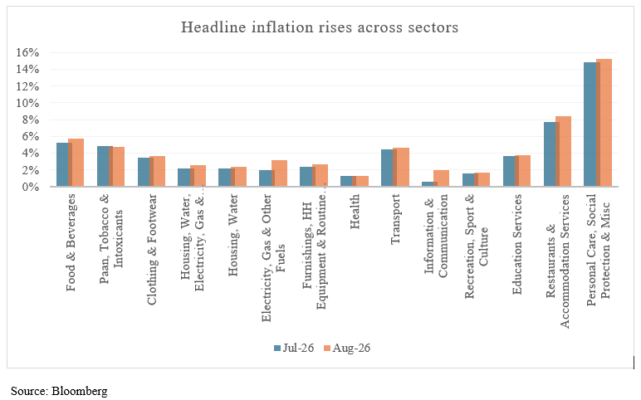
Surging global yields and the recent uptick in Brent prices have continued to weigh on the domestic bond market. The RBI’s concessional forex swap facility for fresh FCNR(B) deposits, introduced to attract foreign currency inflows and support the INR, has subsequently contributed to a significant increase in banking-system liquidity, raising concerns over potential inflationary pressures.
Banking-system liquidity stood at Rs 10.41 trln as of September 14, equivalent to ~3.8% of NDTL. Despite conducting multiple VRRR operations, including 26-day and 30-day operations, the RBI has been unable to absorb the excess liquidity, with overnight call rates remaining below the SDF rate of 5%. Against this backdrop, the RBI announced Rs 1 trln of OMO sales in three tranches. The announcement triggered a sharp rise in bond yields, with the 10-year IGB yield moving towards 7.10%, the 5-year IGB yield rising to 6.80%, and the 10-year AAA PSU yield increasing to 7.65%.
However, a single Rs 1 trln OMO programme is unlikely to be sufficient to bring banking-system liquidity closer to the RBI’s preferred level of ~1.5% of NDTL. The central bank may therefore need to conduct additional OMO sales, alongside allowing the existing FX sell/buy swaps to mature over the next 3–6 months. Until the excess liquidity is adequately absorbed, however, its impact on money-market conditions and inflation could remain a concern. Given the combined pressure from elevated global yields, higher crude prices and persistent domestic liquidity, the risk of a rate-hike cycle beginning as early as October has increased.
Disclaimer: The content of this article is for informational purposes only and should not be considered financial or investment advice. Investments in financial markets are subject to market risks, and past performance is not indicative of future results. Readers are strongly advised to consult a licensed financial expert or advisor for tailored advice before making any investment decisions. The data and information presented in this article may not be accurate, comprehensive, or up-to-date. Readers should not rely solely on the content of this article for any current or future financial reference.